

The Way Finland Plays.
A story about the most consistent nation in hockey, their quiet resilience, and a culture like none other.
When the final horn sounded at the Milano Santagiulia Arena, forever etching a 6-1 Bronze Medal victory for Finland into the history books, there was no outpouring of emotion. No sticks tossed, or gloves flying. Some subdued taps and hugs amongst teammates was the most we saw. From the outside looking in, this might almost seem strange. A country of just 5.6 Million people, roughly the size of Minnesota, so accustomed to success on hockey’s biggest stage that moments like this might begin to feel routine. But in some ways, how could it not?
Finland has medaled in seven of the past nine Olympic tournaments, and no country has won more since NHL players first joined the field in 1998. It would be a mistake to interpret this calm as expectation. It is, instead, a trust in a system, in one another, and a resilience that has historically defined the Finns not just as hockey players, but as people. In Finland, there is a word for this kind of determination.
“Sisu”, has no direct english translation, but it aims to describe a quiet grit in the face of adversity, something that is deeply held within Finnish culture. This very concept was seen throughout the Olympics, both in enduring the entire tournament without their injured captain, Aleksander Barkov, the first Finnish-born captain to win the Stanley Cup, and dominating in the Bronze Medal game without what many would consider to be the most talented Finn of this generation, Mikko Rantanen. As is often the case, the path to Bronze was not without its fair share of agony.
In the Semi-Final game versus a juggernaut Team Canada that many pre-tournament were dubbing one of the strongest ever assembled, Finland battled their way into a 2-0 lead early in the 2nd period in a way that, to anyone who had been paying attention, felt familiar. Structured, disciplined, and patient. But as so often is the case in hockey, the game began to shift, slowly at first, then all at once. Superstar-stacked Team Canada responded in full force, until, after a controversial penalty call, completed the comeback via a Nathan MacKinnon goal with just 36 seconds left to advance to the Gold Medal game. For most teams, it’d be easy to linger on such a loss. 20 minutes away from a shot at the ultimate prize in international hockey ending in not only about as heart-breaking of a defeat as the sport has to offer, but also coming at the price of a long term injury to their leading scorer throughout the competition, Mikko Rantanen.
For the Finns however, there was no time to dwell. Less than 24 hours later they would find themselves back on the ice to try to leave Milan with a medal around their necks against a scrappy Slovakia team that not only had one of the most impressive tournaments of any team, but also shut out Finland 4-0 in their opening game of the Olympics. The challenge in front of them was as mental as it was physical, one last chance to regroup, recover, and respond; and respond they did.
The mental fortitude that has come to define Finnish hockey once again landed them on a podium. It took gritty, fully-committed performances from players like Erik Haula, the most tenured Finn on the roster, who led the way with 2 goals and battled for every puck.
To understand exactly what this Bronze Medal means, you have to understand what hockey itself means to the country of Finland. In Finland, hockey is more than a sport, it’s a universal language, one that is woven into the very fabric of daily life, community and national identity for many Finns. It’s a massive source of pride for a notoriously proud people, the stage to showcase the Finnish way that carries far beyond the arenas it’s played in. Very few understand this culture better than Erik Haula, the Pori native who has spent the past 15 years carving out a decorated NHL career, and representing the Finnish National Team on just about every imaginable stage. When Puckuomi reached out to the Nashville Predators, they were kind enough to sit down with Haula on our behalf. I wanted to know how someone raised within it would describe Finnish hockey culture to those who haven’t experienced it.
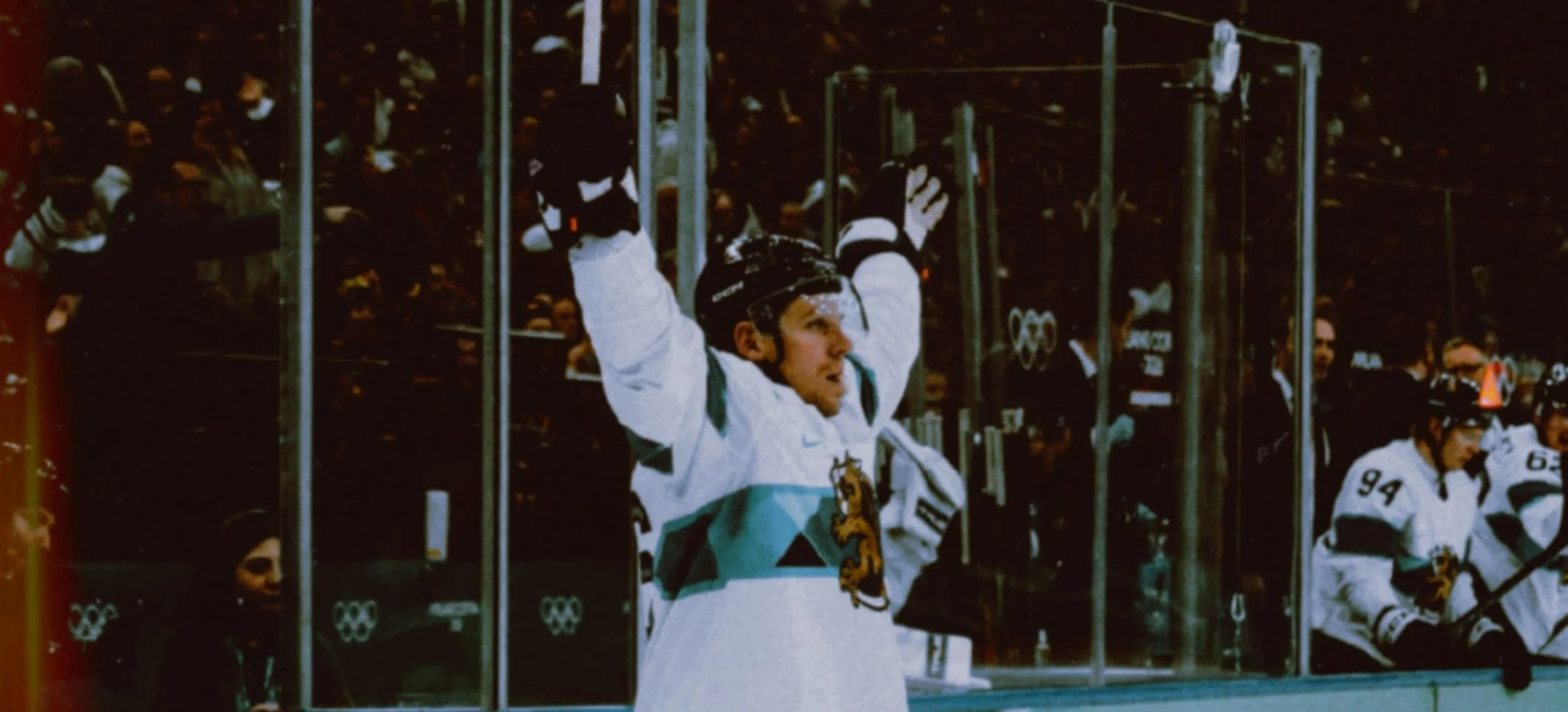
“Hockey’s probably the number one sport in Finland… The access I had to open ice and outdoor rinks as a kid, just around where I grew up, was exceptional. I did that growing up all the time, bike to an outdoor rink, walk… it was part of my childhood and life. I think Hockey means a lot to the population of Finland.”
This image that Haula describes, riding your bike through icy streets, or trudging through snowy sidewalks, Hockey bag slung over your shoulder, to go play the game you love until the floodlights come on, isn’t a romantic abstraction, it is a lived reality for thousands of Finnish kids every winter, and a tradition that has created generation after generation of not just capable NHL players, but some of the very best in the league.
Roughly 1.3% of the total population in Finland is registered with the International Ice Hockey Federation, the highest of any nation outside of Canada. In Finland, these rinks are gathering places, third spaces integral to communities, and bright spots in some of the most brutal winters you’ll find anywhere on Earth. In a day and age where many kids are being priced out of the sport due to the exponential costs of youth hockey, the importance of these accessible spaces are invaluable in the development of the next generation of players.
And yet, for all the infrastructure, the frozen ponds and local rinks, Finland’s most decorated players will tell you what matters most is something much, much harder to build. When Puckuomi asked Erik Haula what representing Finland means to him personally, his answer didn’t touch on tactics, or talent, or the weight of expectations. It went somewhere quieter.
“It's such an honor… it's hard to describe the camaraderie the teams always have when they do get together, if they've known each other for multiple years or not. That's Finland's strength… coming together really fast. And I think that's the reason why we've always done so well.
It’s a disarmingly beautiful way to describe arguably the most consistent international hockey program we’ve ever seen. The infrastructure and a near-obsessive hockey culture gave Finland these players, but what has given them their continued success is something much more intangible; a fanatic willingness to dissolve ambition of the self in the name of a shared goal, and to do it quickly. We have seen high-scoring, highlight reel Finnish players before, the likes of Teemu Selänne or Jari Kurri, but throughout the history of the game, the “prototypical” Finnish hockey player has looked relatively the same. Selfless, disciplined, and relentless.
It’s no surprise really, that Finnish hockey has taken the form it has over the years. Finland declared its independence barely over 100 years ago, and in that time it has developed a national identity centered around resilience, grit, and a willingness to stand for the person next to you. This is nothing new, and it's always been bigger than hockey. This has always been the way Finland plays.
And maybe that’s why, when the final horn sounded, there was no outpouring of emotion. No sticks tossed. No gloves flying. This calm was the result of a country that has been doing this for a long time, in the only way it has ever known how. Together. For Finland, moments like this can’t be surprising, because they are never sudden. They are the direct result of a childhood spent hiking through an endless winter to play the game that raised you, until one day, you find yourself on the biggest stage it has to offer, pulling on a jersey that means everything to you, standing side by side with guys who used to be that kid too.
There are bigger hockey nations, louder ones, nations with more talent, more resources. But there is no nation that has made more of what it has, more consistently, over a longer period of time, than Finland. And there is no story in the sport more worth telling.
Special thanks goes out to Nick Barnowski of the Nashville Predators for making this article possible. Below you can find the full audio of the Erik Haula quotes.
