

MOCKUOMI: 2026 NHL 1st Round Mock Draft
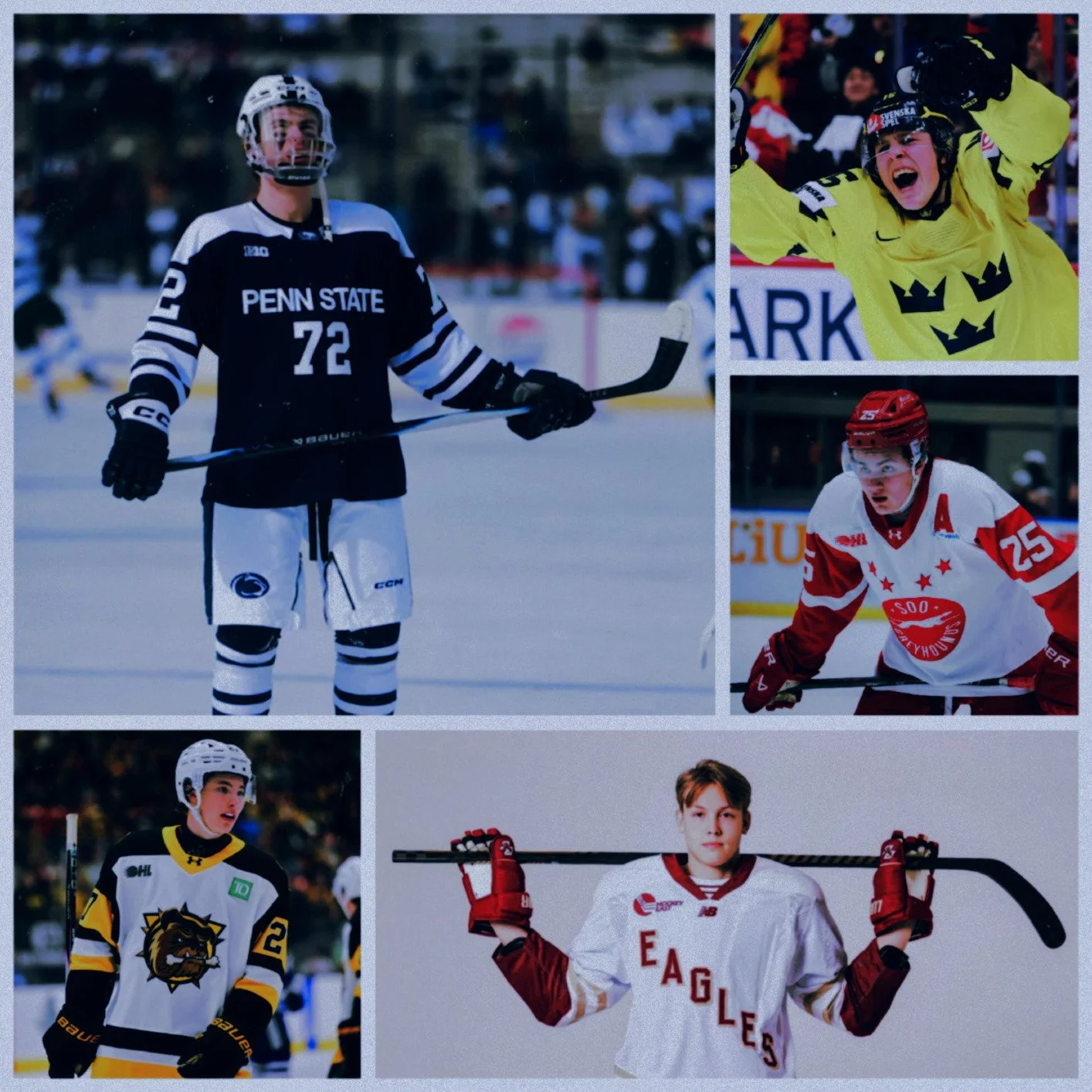
1. Toronto Maple Leafs: Gavin McKenna, LW
After missing the playoffs for the first time since they last found themselves with the first overall pick, the Leafs are once again in the driver seat to select a potential franchise altering player to finally get them over the hump. Enter Gavin McKenna. For McKenna, it hasn’t been the sort of clear cut, runaway 1st Overall path we’ve seen in recent memory with guys like Conor Bedard or Macklin Celebrini. Early season struggles, a now-dropped assault charge stemming from a bar fight back in January, and some stellar play from the guys below him on this list all casted some doubt on McKenna’s status as a bonafide, no doubt #1 pick. But after a brilliant second half of his season, including a monstrous 8 point game against Ohio State, we are more or less back where we started with Gavin.
The talent is self-evident, it’s popped off the screen at every level he’s played at, whether in college, or international tournaments, or his beyond historic time in the WHL, he’s looked like the best player on the ice everywhere he’s went. He’s a hockey genius, an offensive architect that elevates every guy around him, this was seen in his most recent campaign, leading a middling Penn State program to what should probably be considered their best season in team history.
His ability as a playmaker and visionary is paired with a very dangerous shot that means defenders can’t just sit on the pass, he forces d-men to make impossible decisions in the blink of an eye and has every tool needed to make them pay if they choose wrong. He’s not without flaw though, He’s slight of frame, and overall, his defensive game needs some work, more concerning than his ability on that end of the ice is his effort level. He has a tendency to drift without the puck, occasionally lose focus and/or engagement defensively. This is not a new thing to see from this kind of elite offensive young player, and when you imagine just how much physical and mental energy must be exerted to be as special as he is offensively, you can kind of imagine how a shift can get away from you a little bit in your own end. This issue normally improves with time and maturity, and if it was my favorite team with a chance at picking McKenna here, I wouldn’t give it much thought, but if you know absolutely anything about the Toronto media, it's the sort of thing they love to zoom in on and pick apart.
That will be a defining question going forward here, can Gavin McKenna handle the pressure of the Toronto spotlight? It’s the same question we’ll hear ad infinitum for every potential top Leafs pick, and it's one that truly only time can answer, so the best Leafs leadership can ever do is bet on talent, and while I don’t think its by quite as wide of a margin as some people seem to believe, I do think Gavin McKenna is the most talented guy in this class.
It’s worth noting that the Leafs are in a massive period of transition up and down the organization. With the controversial hiring of John Chayka as GM, franchise legend Mats Sundin coming on as a senior advisor, and the recent hiring of head coach Jim Hiller, the message is clear. It’s a new era in Toronto. Whether Auston Matthews sticks around to get served goals on a platter by the new guy, or passes on the “face of the franchise” torch, Gavin McKenna is the Toronto Maple Leafs best guess at a vision forward.
2. San Jose Sharks: Ivar Stenberg, LW/RW
I’m gonna have to let you guys in on a little inside baseball here. This mock was, for all intents and purposes, completed and ready to be published by Tuesday morning. That is, until, three days away from the draft suddenly turned into trade deadline day, and the entire spectrum of both draft order and strategy was flipped on its head. I had, in great detail, gushed over the talent and fit of Chase Reid here at number 2. Which, for the record, I still think would be a perfectly reasonable choice, but the entire narrative leading up to this draft was that with San Jose, possessing an embarrassment of riches in the young forwards department, and a flashing red need at the blue line, using this pick to add Ivar Stenberg would be great, but ultimately, irresponsible.
I guess I, as an analyst, failed to consider that Mike Grier and the Sharks leadership team are operating in a flow state that allows them to do seemingly anything they want. If you don’t know specifically what I’m referring to, Tuesday afternoon the San Jose Sharks traded William Ecklund and a pair of prospects to the Ottawa Senators in exchange for this year's 9th overall pick, which they recently acquired in the Brady Tkachuk to Florida blockbuster. In other draft classes, I don’t think this move automatically changes the Sharks strategy, but this year, it’s fairly groundbreaking.
I want to be very clear about two things. First, we will discuss lopsided trades that I hate for one side later on, but this isn’t the case here. I am very high on the futures of especially William Eklund, as well as Kasper Halttunen, I think Ottawa made the best out of a bad situation. Secondly, Chase Reid is a prospect I absolutely love, and for me he comfortably headlines a defensemen draft class that is my favorite in a very long time. That being said, San Jose circumventing the logjam at future top six forwards to allow the selection of Stenberg while also obtaining the means at #9 to pick a d-man who has every chance to become the Powerplay QB1 this team is desperately in need of is undeniably a stroke of genius.
Ivar Stenberg, to his credit, has done absolutely everything you should expect from a 1st overall pick. When playing amongst players in his own age range either in Swedish youth leagues or at the World Juniors, he was dominant, more often than not the best player on the ice by a fair margin. When most recently matched up against grown men in the SHL and IIHF World Championship, he excelled in a way virtually never seen out of an 18 year old.
I could talk ad nauseum about his edgework, deceptive change of pace, elite playmaking, rapid release, and 200 foot effort. So much of what he does is excelptional that dialing into any one aspect too deeply feels like a disservice. Of course, there are things here you can pick at, unremarkable size, if NHL spacing might slow down his processing ability, he’s a guy you could let yourself overthink.
But the San Jose Sharks have done the hardest part, making the need and the best player available align. The long term outlook of pairing a guy like Stenberg with Macklin Celebrini is something I can only describe as unfair, and years from now I think there's a very real chance we’re all trying to remember where we were on this random Tuesday.
3. Vancouver Canucks: Caleb Malhotra, C
This was originally the point in the mock where I had to decide if I was trying to predict what is going to happen at this Friday's draft, or what I think should happen, and I went with the prediction angle. While some trustworthy analysts have stated this isn’t as much of a lock as we’ve all been led to believe, in light of recent events, the depth and volume of noise around Caleb Malhotra to the Canucks is impossible to ignore. The obvious connection being made by everyone is the recent hiring of Caleb’s father, Manny Malhotra, as the newest head coach of the Vancouver Canucks, but those close to the situation have suggested that the familial tie is more seen as a complication to drafting Caleb, rather than a reason to do so. New GM Ryan Johnson has said publicly that if Malhotra is the direction they go here, that will be a decision made solely for hockey reasons, and I don’t personally see any reason not to believe him.
For Canucks fans (a group I unfortunately belong to), it’s going to be a little bit bitter to watch a team that has had a diagnosable hyperfixation on Swedish talent see a prospect the likes of Ivar Stenberg go just one selection before, but Caleb Malhotra is a hell of a “consolation prize”. Big, strong, prototypical size for a Center, reportedly very high character kid, dog-on-a-bone mentality, and the best attention to detail in the entire class, the more you watch and learn about him the more this all starts to make sense.
The new leadership group in Vancouver, namely, Manny Malhotra, Ryan Johnson, and the Sedin Twins, have said over and over again how much they want to prioritize character and culture as they begin this rebuild, and I’m of the opinion that they’re right to do so. Frankly, bad work ethic, commitment, and locker room cohesion imploded the Vancouver Canucks far before their lack of talent ever could. A lot has been said about Caleb’s projectability as a mature, responsible leader, and I’m not surprised that that is an attractive prospect for a club that has been beyond desperate for a steady set of hands for years now. I admittedly do still see Ivar Stenberg as a slight tier above Malhotra, but Center is a premium position and easily the weakest group on the Canucks roster. Said Center group is likely to get even weaker with massive questions surrounding Elias Petterson’s future and Filip Chytil’s health, we are genuinely a few completely feasible events away from a season of Aatu Raty 2C minutes, which honestly I think would be awesome, but you get my point.
The scoring production in his draft season isn’t blowing anyone away but the leaps and bounds he took throughout the year can’t be ignored, culminating in an undeniably brilliant playoff run to finish his year, flat out, this guy got better every single time we saw him on the ice. He has one of the highest floors of the entire draft, and projects very easily as a 2C at the NHL level, maybe something more if his offensive potential is realized. I understand if that doesn’t exactly sound like a home run at 3rd Overall, but the whole thing is very reminiscent of another OHL Center pick that the fans had mixed feelings on, Bo Horvat, and regardless of how it all turned out, I think if you can ever exit a process as uncertain as the NHL Draft with a player of that quality, you say thank you and keep it moving.
The father/son story is the elephant in the room and the one thing I’m still uneasy about. If it works, great, beautiful, one of the best stories in the sport. But if the team stinks as bad as we all think it’s probably going to for awhile and the Canucks brass suddenly isn’t as patient with Manny as they swear they’re going to be, how do you explain that to a probably just now emerging Caleb? Or if Caleb doesn’t quite pan out how does that weigh on his dad behind the bench? God forbid the worst of both worlds and the entire thing just looks like a giant nepotistic disaster. It is undoubtedly adding more questions to a franchise already ripping the floorboards up to find answers, but I still think it’s the correct first step in a long journey putting guys in the room who will work to redefine what it means to be a Vancouver Canuck.
4. Buffalo Sabres: Chase Reid, D
Okay, listen. I recognize it may be poor form to use the Buffalo Sabres slot to talk about another team, but reports say they might be moving this pick by draft day anyways, and the Chicago Blackhawks no longer have another first rounder, so I’d just like to say something. The Sabres acquired this selection, the 45th overall pick, and forward Louis Crever, in exchange for defenseman Bowen Byram and forward Jordan Greenway. I understand the need to show an immediate competitive future to Connor Bedard, the Blackhawks have yet to finish above 31st in the league in his time there. I don’t by any means dislike Bo Byram as a player, and see that he adds an element they haven’t had from a blue liner in quite some time. I cannot, for all these caveats, see this move by Blackhawks GM Kyle Davidson, as anything less than malpractice.
The reports and easiest justification here is that Chicago was fixated at Stenberg at #4, something that seemed entirely reasonable in a pre-San Jose trade world, and once that suddenly dematerialized they felt pressured into a pivot. I can genuinely understand that if the player you center this pivot around is at least an approximation of some realized version of Stenberg, someone you see the traits that captivated you within, even at the cost of some long-term potential. What I can’t understand is a pivot that lands you an entirely different player in an entirely different role. Specifically when a version of that player and role has now opened up to you in a younger, better way, i.e. Chase Reid. I get why immediate improvement is more appetizing than a longer project right now, but I respectfully don’t think anyone on earth sees Byram as the difference between 31st overall and a playoff spot in a brutal Central Division. Of course a fair response to this would be “they’re not done, it’s a process.” but for a swing like this in a relatively week Free Agency class, you better be sure that you have the assets and partners to not be done, and frankly I think any Blackhawks fan would be the first to tell you there’s no inherent reason to trust this process.
Okay, right, this is supposed to be about the Sabres. Sorry. There’s apparently every reason to believe this pick is gonna be used to obtain another piece, maybe Connor Hellebuyck, maybe something else, but if I don’t get this piece out before another blockbuster happens I’m deleting the fucking website. Beyond that personal bias, I don’t hate a stick and pick for Buffalo whatsoever here. They’ve made it clear they’re all in on this newfound success and while their ascension is one of my favorite stories from this past season, I think based on their recent history I would still love to see them proceed with some level of caution and eye towards the future.
The best way to do this is through the philosophy of best player available, and in my eyes that’s Chase Reid. Again, I won’t be shy or hedge my bets here, I can’t rave enough about this crop of defenseman, I think we’re looking at more undeniable, long term NHLers than we’ve seen in a while and if I had you had to pick the absolute best it’s Chase Reid.
His ascension to where we perceive him now is worthy of an article all of its own, a year removed from being cut from an NAHL squad, his journey here is about as earned as you’re ever gonna find for a top 5 pick. Amongst this class he’s set himself apart with his elite economy of movement, projectable Powerplay QB upside, and nuance as a shooter.
This tantalizing offensive upside does come at the cost of an occasional tendency to sell out and an overreliance on his shot which has created some untapped potential as a playmaker, but in a world where it’s Buffalo here, their shipping of both Byram and Kesselring in the past week point to a confidence in their D group, and in a world where you have the time to wait on Chase Reid I think he’s the exact type of player that can help take this Sabres squad from scrappy competitor to perennial contender.
5. New York Rangers: Carson Carels, D
While trade results will have massive implications throughout both this draft and this mock, I am grateful to report that this is the pick I’ve seen here for a while. You can pick out a lot of needs in this current iteration of NYR, they’re stuck in a complicated position that lands equally between a good time to start a rebuild and a last chance and building something competitive.
I have my own opinions about which of those options is most productive but regardless of what camp you fall into you stay and pick Carels here. The ineptitude of picking, developing, and/or maintaining defensemen in New York is well-documented and real but I think Carson at this spot is the best synergy you’ll find between best player available and flexibility of timeline. If a meltdown and blow up is around the corner I think he’s already displayed an array of intangibles that make a shorter runway than that of other d-men in this class totally feasible. If the Rangers happen to find a way to make this current group more immediately competitive, his current NCAA commitment at North Dakota have a proven and respectable developmental history.
There’s an easily imaginable upside to Carels that puts him even closer to the top of this draft, but even if that isn’t reached I still think he settles in to a high end, top 4, minutes eating role. From movement, to play killing, everything this guy does is just clean, he never seems rushed, his reads are always controlled, and for a team that has missed on home run swings in the past at this position, I think they’d do well for themselves to draft a player who still shows some of the tools you dream of, but can settle into whatever this team is actually becoming.
6. Calgary Flames: Viggo Björk, C
The most recent Flames trade acquisition of Šimon Nemec from the New Jersey Devils is by no means where their work defensively has to end but I do think it’s telling. I see it as a shot on a young defenseman, which is the kind of shot that many were expecting to see them take at this draft. What that points to, for me at least, is a desire to make a different kind of bet, one that might hinge on easily the biggest riser of this entire draft, Viggo Björk.
For all that I raved about Ivar Stenberg’s accomplishments this year playing against SHL and World Championship competition, the closest comparison we saw in the metrics time and time again consisted of high level former and current NHLers, and Viggo Björk.
Generally speaking, the Flames have drafted with what I perceive as a bias towards safety, with mostly reasonable success. Viggo, in comparison, is an undersized Center, an archetype that draft rooms often see as volatile and are hesitant to attach their names to. He measures in at 5’9”, which has obviously been one the most defining factors of discussion around him but even still it’s hard to find anyone who would say it’s a noticeable trait when you actually watch him. He plays with immense IQ and a level of strength both along the boards and in open ice that makes bringing up his listed size eventually feel kind of asinine.
I’ve always found player comparisons within prospect evaluation more pointless than productive but if you find it personally helpful the name you’re going to hear over and over again is Brayden Point. While I wouldn’t fully compare the players I do think the recent, very tangible success of Logan Stankoven both in general and especially in a playoff setting is kind of a proof of concept here. The importance of size, particularly at the highest level of the sport, is not fully a mirage, but there have been countless examples of big bodies who cannot play to their size, and a shortlist of prospects who have demonstrated an ability to play above it quite like Viggo.
Often what you see allow smaller players to excel is an explosive skating portfolio that lets them mitigate physicality battles they’ll mostly lose, that’s not the case here. There isn’t, that we’ve seen at least, a ton of explosiveness to his game. There's nothing wrong with his quickness and agility by any means, but his success as an NHL skater will primarily hinge on his impressive puck protection skills and advanced processing ability.
Point being, this Flames team has a ways to go, and even if you see Viggo as a risk, it’s a risk they’ve been waiting for a chance to take for long enough.
7. Seattle Kraken: Keaton Verhoeff, D
There’s a certain poetry if these picks do line up, going from the first round’s biggest riser, to potentially its biggest faller in Keaton Verhoeff. For the past year or two in those “Way Too Early 2026 NHL Mock Draft” articles he was the one name you were most likely to see before McKenna, and it’s not hard to see why. Premium position as a right-shot defenseman, massive frame, silky skating for his stature, heaviest shot in the class, great offensive instincts. So, where did it go wrong?
The easiest way to put it is that he made a bet on himself that just never paid off. Another season racking up production in the WHL might’ve led to us having a very different conversation right now, but instead Keaton chose to make the jump to NCAA Hockey with North Dakota, and in the process, exposed flaws that were previously not attached to him.
At a higher level, his skating was less impressive, his stop start capabilities noticeably lacked burst. Against more sophisticated, aggressive forechecks, he struggled with decision making, hesitating his way into costly and sometimes flat out ugly turnovers. More or less, that defined the Verhoeff college hockey experience, all the tools and skills that had him mocked #1 still exist, just seen more in bursts than consistency, and the deficits highlighted in the most visceral way.
Credible prospect rankings range drastically on Keaton, anywhere from #4 to #12, I’m personally on the higher side of those but more specifically a fan of the fit here in Seattle. Virtually everyone has the Kraken bucking their trend and drafting a defenseman in the first round for the first time in their short franchise history, and I’m inclined to agree.
There’s at least 3 defensemen names I wouldn’t mind here but the overwhelming (and true) narrative surrounding Seattle is a lack of top end talent and potential, I see Verhoeff's floor slightly lower than those in his tier but his possible ceiling is one that could change the ceiling of the Seattle Kraken in general, and whatever they do here, that has to be the goal.
8. Winnipeg Jets: Alberts Šmits, D
Even to the extent that this is all an exercise in guess work, not much need to over complicate this one. Another riser in this draft class, Alberts has been put on a lot of stages this year, playing for Jukurit in Finland’s top league, Liiga, representing Latvia at World Juniors, the Olympics and the World Championship and finishing his club campaign on loan to EHC München in Germany’s premier league. Apart from München, I watched just about every one of these games, and the singular thing that stood out beyond any specific skill was how evidently he belonged.
The Jets are a team I have a hard time identifying a specifically overwhelming strength or weakness, as disastrous as this past season was, I think their recent track record suggests they need another year to discover how much of their secondary scoring drop off and overall regression is to be believed.
Ultimately, I think the best versions of Jets teams we’ve seen since their NHL reintroduction were mostly formed around the same identity and core thesis. Intelligence, structure, and relentless compete, and when combined with current needs, I think the prospect who exemplifies these traits the most still available at this spot is Alberts Šmits. The pro traits he’s showcased at every level suggest that he could be a trustworthy contributor faster than a lot of this class if the aging core continues to struggle and Winnipeg pivots towards youth.
There’s very real questions around if another offensive gear actually exists beyond bursts and if he can become dynamic enough to warrant this top 10 selection, but virtually no one that's likely to be available here are as projectable and NHL ready.
9. San Jose Sharks: Daxon Rudolph, D
After picking Stenberg at #2, I think getting Daxon Rudolph here at #9 will just about lock up an A+ round one draft grade for San Jose. While he is a clear tier below I think a lot of traits I love about Chase Reid, specifically traits I love as the pertain to the fit in San Jose, can be found here in Daxon as well.
He’s a fantastic skater, his edgework and fluidity in his hips give him great escapability and change of direction, very very difficult guy to pin down on the forecheck. He’s one of the better transition drivers in the class in a way that feels directly translatable to the NHL, he moves the puck quickly and efficiently, consistently allowing his teams to play fast, which makes me think he could be the perfect compliment and blue line facilitator to this young Sharks forward core. Add his absolutely booming shot to this and the offensive upside may just be the strongest in the class.
He doesn’t have the biggest or strongest frame, we occasionally saw him get bullied in certain situations either in net front battles or along the boards, NHL level strength and conditioning training will help with this but if he hopes to be a true, everyday #1 guy, more defensive ceiling than is currently obvious will need to be materialized. I think he could immediately do himself a favor by simply playing with more aggression defensively, as some scouts see him as a bit too passive in that regard.
Regardless, I think it’s a beautiful fit here and where San Jose will go with the pick if given the opportunity.
10. Nashville Predators: Tynan Lawrence, C
I could see a number of directions that make sense for the Preds at #10 here, but I think they should and will look to add a piece that can alter their offensive ceiling and unlock some of the skill they have on their wings, Tynan Lawrence is a great name for that vision.
Lawrence's time at Boston University this year lacked overall consistency, but when he was on, he was one of the most enjoyable guys to watch in all of college hockey. It’s not just that he skates fast, which he does, but more so his ability to maintain his skill and hands at top speed. A lot of guys have good mitts in static situations, but the way Tynan combines this skill with natural explosiveness is rare among this class and among players his age in general.
He was the second youngest player in all of NCAA Men’s hockey and still showcased a reliable, two way game to go along with the offensive flashes, all while maintaining relentless pace and compete on a nightly basis. He’ll return to a great program in BU which I think is a perfect place for him to continue his development.
Most of his downsides you can still chalk up to youth at this point, the most glaring being shift-to-shift consistency and decision making, love the aggression he plays with but there’s undeniably refinement still needed.
Similar to what I was hinting at with Winnipeg, the identity of structure and discipline in Nashville is good, but the next step in evolution is going to require some swings at guys who will one day have a shot at tilting the ice for you.
11. St. Louis Blues: Wyatt Cullen, LW/RW
Son of 3x Stanley Cup Champion Matt Cullen, the hockey pedigree is obvious here. The range of perception on him is about as wide as anyone in the first round, Elite Prospects has him at #6, while other prominent voices place him in the early to mid 20s. This is ultimately a pretty big take on offensive upside here but in my opinion few teams in this range feel more likely to prioritize projectability and translatability than St. Louis.
With the recent trade departure of Jordan Kyrou, and finding themselves in between rebuilding and retooling, this draft, in which they’ve worked their way into 4 first round selections, is as crucial of a turning point as you can imagine for the Blues. Because of this wealth of draft capital, I think they can afford to be aggressive here and take a chance on legitimate top-six offensive potential.
Cullen is an extremely cerebral player, reads the game at a much higher level and pace than is typical for his age. He combines his sophisticated hockey mind with a level of effort and work ethic that never quits, which overall makes him a guy scouts have liked more and more with every showing.
This is an incredibly strong foundation for any offensive player to have, but it’s going to be wait-and-see for awhile if he has any one singular tool or skill that is a true separator at the next level. He’s committed to the University of Minnesota next season so if the Blues do go with him here they wont have to wait long to see him take the next jump in competition.
12. New Jersey Devils: Ethan Belchetz, LW
A broken clavicle cut Ethan Belchetz OHL campaign for the Windsor Spitfire short this season, but while healthy and on the ice, there was no way to describe this kid beyond a complete handful. Prototypical Power Forward size at 6’5” and 230 lbs, there were virtually no OHL defenders capable of stopping him in a straight line when he was doing what he does best, driving to the net, hammering shots on net, and wreaking havoc overall.
I think there’s still room to grow for Belchetz when it comes to using the most of his frame with more consistent aggression and maintaining physicality at all times, but the tools are impossible not to love. The main determining factor between whether he becomes a bottom-six, occasional difference maker, or a true top end game breaker primarily hinges on the development of his skating ability, which has taken genuinely encouraging steps throughout the draft cycle, but still has a ways to go.
In short, what Belchetz offers is a big body with plenty of skill and more than enough reason to believe that further refinement could transform him into a top 5 guy in this draft, that’s a pitch plenty of teams would be smart to buy into, and I see New Jersey as the first one willing to do so.
13. New York Islanders: Oscar Hemming, LW
Hope you’re sitting down for this one but the Finnish hockey guy is pretty high on the most intriguing Finnish prospect in the class, shocker, huh? In all seriousness, I don’t think this is any of my Finnish bias that I’m typically more than happy to admit to coming into play here.
There’s virtually no player in this entire class that I see the numbers and counting stats less representative of than Oscar Hemming. A contractual dispute with his Liiga Club, Kiekka-Espoo, delayed Oscar from beginning his NCAA debut at Boston College until about midway through the season. He got off to a hot start, one that I actually find more telling of him as a prospect than the overall result. He ultimately struggled to catch up and adjust, finishing with a total of eight points and just one goal in eighteen games played. I don’t claim to be an absolute authority on college hockey but I’m willing to say with some level of certainty that I can’t recall a player with a heavier, more nuanced shot registering just one goal in eighteen games.
I think most scouts are aware of this somewhat deceptive NCAA season, so with the skill not accurately represented, they turn to the tools. Scouts and GMs famously fixate on late birthdays and young-for-the-class prospects, and if that's your bag, look no further. Hemming was the youngest player in all of division one collegiate hockey once he arrived and is one of the youngest in this class at large, and even still, at 6’4”, he more often than not looked like a man amongst boys.
Oscar represents, to most, the 1B to Belchetz 1A in the realm of Power Forwards in this class, but I personally find the floor and ceiling slightly more intriguing here. I believe, with a fair amount of confidence, that Hemming bottoms out in a middle-six NHL slot, and if fully realized, this is the type of player you dream of having in a playoff run.
14. Columbus Blue Jackets: Malte Gustaffson, D
Columbus has drafted with admirable patience and genuine conviction over the past few years, and I think this pick reflects exactly that. Malte Gustafsson isn't the loudest name at the position in this class, but the Blue Jackets have shown a consistent ability to identify what a player will become rather than reacting to what he already is, and what Gustafsson is becoming is something worth paying attention to.
He’s incredibly smooth for his massive 6’4” frame, my favorite trait of his that I can highlight is the poise he shows as a passer, particularly in outlet situations. While he’s not entirely immune to being rushed into poor decisions, when playing within himself and his current level of comfortability, which I’m sure will continue to grow, there’s very few D-men who showcase his processing acumen as both a facilitator and a play disruptor. The current projectable offensive ceiling lacks a touch of excitement, but not many match his outlook as a complete, two-way blueliner,
If this is a pick here, it won’t make many headlines, but if a larger picture gets figured out in Columbus, check back in 5 years.
15. St. Louis Blues: Ryan Lin, D
This feels relatively crazy to say about a player I’m mocking at 15th, but there’s sincerely been a couple years in recent memory where a guy like Ryan Lin could’ve been the 2nd or 3rd Defenseman off the board.
He contains the same two-way profile that scouts love, while also mostly avoiding the “jack of all trades, master of none” pitfall that we often see. A lot of players in this same mold and range lack a defining trait, but I don’t think that’s the case here. For Lin, I see his edgework and change of direction as good as any blue liner in the class, if not the best. This is combined with excellent vision and processing ability, he makes the right play so often, and it’s translated into the exact kind of numbers you’re hoping to see from a young defenseman prospect in the WHL.
There’s tools and traits that separate guys like Chase Reid, Carson Carels, and Keaton Verhoeff as a tier above, but if there’s any one prospect in this range I believe in to catch up to those guys it’s far and away Ryan Lin.
16. St. Louis Blues: Alexander Command, C
Whatever your feelings are on the Jordan Kyrou trade (I personally love it for both teams) it's impossible to look at what St. Louis could build through this draft with anything less than cautious optimism. Command here gives them a center with legitimate offensive instincts to complement what they've accumulated on the blue line and wings in the two picks prior.
He's a cerebral player, he reads developing plays with a quickness that reminds you there are different kinds of athleticism, and spatial intelligence is absolutely one of them. The offensive zone structure he demonstrates at his age is the kind of thing you normally have to wait on, and the fact that it's already there is probably what has him going in the first round over some guys who might have a stronger rate-stat argument.
Questions around his skating are real and worth monitoring, it's the one area where the transition to pro hockey could expose him in a way his hockey sense can't fully compensate for. But for a Blues team that’s now able to add the kind of organizational depth you can be patient with, Command is exactly the sort of projectable center they can feel simultaneously safe and excited about.
17. Los Angeles Kings: Oliver Suvanto, C
The next Finn off the board is potentially the safest pick you could ever hope to find in the late-teens. There’s a word here that I think defines Oliver Suvanto as well as anyone in this entire draft class. Responsible. Despite being one of the younger players available, his game is potentially the most mature of anyone in this class. It’s been awhile since we’ve seen a prospect this quintessentially, almost stereotypically Finnish.
He plays all 200-feet without a dip in focus, uses his 6’3” frame to dominate physically throughout the ice, elite stability and confidence while acting as the anchor of the defense down low, easily believable as the guy you send out for the most important faceoffs of the game.
I’ve already expressed that I don’t care for player comparisons all that much but I think some of the ones here are worth mentioning. Anton Lundell is the most direct comp you’re likely to hear but the connection towards Aleksander Barkov can’t be ignored either. Not only was Suvanto one of the rare players to reach a Liiga senior team roster spot before age 17 he did so as a part of Tappara, the club owned in part by Barkov himself, and as Barkov rehabbed his return to hockey for the 2026 IIHF World Championships, one of the skaters he worked with was none other than Suvanto.
The offensive upside is the main question mark, he’s yet to display any meaningful ability at chance creation, but he represents one of the most NHL ready prospects at a key position and his defensive ability is so far advanced beyond his age that you can virtually guarantee his floor being a useful player at some level.
18. Washington Capitals: Ilia Morozov, C
The other name I went back and forth on here was Alexander Command, I mocked Alexander a few spots ahead but I still completely see a world in which that’s the decision the Caps are making come draft night. I think it’s an interesting dichotomy between the two, you’d be hard pressed to find two more diametrically opposed Center prospects in this class than Morozov and Command. Command represents a much much safer floor, while Morozov is one of the biggest home run swings any team is likely to take in this range.
The Russian-born center has great offensive instincts and the kind of playmaking ability that tends to translate even when other parts of the game are still catching up. He made the jump to college hockey this season at Miami (OH), and was a key part of turning an absolutely humiliating program into a perfectly respectable one.
With his physical tools and level of compete, many scouts see his upside as dangerous as any Center available, but if they’re unrealized it could be somewhat hard to imagine his exact role at a higher level.
With the recent trade acquisitions of Jordan Kyrou and Alex Tuch, the Capitals haven’t been shy in announcing their intentions to compete for the next 3-5 years, and that feels like the perfect window to allow a potentially game breaking Center to develop behind the scenes.
19. Utah Mammoth: Adam Novotny, LW
If this pick is available to Utah at this spot like I and many others project it to be, they should go home from round one of the draft feeling as good as just about anyone. The Utah Mammoth, to this point, have accomplished something incredibly difficult, which is, playing competitive, good hockey, while still working to develop a core, long-term philosophy.
Something I think is crucial to their current identity has been finding stars in the margins, guys who first and foremost present as having a team above everything mentality and high level of work ethic, while also possessing the ability to take over games from time to time.
Czech Winger Adam Novotny matches this description about as well as you could find anywhere on the board, he exemplifies the team first mentality while still possessing a ton of scoring upside due to his dedication to putting pucks on net whenever possible.
20. Buffalo Sabres: Nikita Klepov, RW
If this is Buffalo's second pick of the night, the organizational message becomes pretty clear: we are going to accumulate skill and sort out the rest later. Klepov is a pure skill player in the most unapologetic sense, his offensive toolkit is extensive, his hands are among the most dangerous in the class in tight spaces, and when he's moving at full speed he's hard to contain.
The questions are the ones you've heard before around this archetype. Consistency, compete level away from the puck, whether the defensive engagement ever becomes reliable enough to earn top-six trust at the NHL level. For a Sabres team that has spent years being physically outmuscled and structurally outworked, there's a version of this addition that feels slightly redundant. But there's also a version where the sheer offensive talent of this group eventually becomes the rising tide, and Klepov looks like a piece that belongs on a dangerous team. At this spot, I'm willing to entertain that version.
21. Philadelphia Flyers: Maksim Sokolovskii, D
The Flyers' blue line has been a wound that no number of offseason bandages has fully closed, and I think at this point the organization knows on some level that the beginning of an answer is more likely to come through the draft rather than this year's free agent market. Sokolovskii is a massive-bodied defenseman with a sort of rare mobility that won’t let him get eaten alive against NHL-caliber speed, which frankly already puts him ahead of some recent Philadelphia experiments at the position.
He's not a finished product by any stretch, there’s still plenty of mocks out there that see him in the early second round. The defensive reads at the NHL level will demand a consistency he hasn't fully demonstrated yet, and the offensive contributions are more complementary than generative at this stage. But there's a real player somewhere in here. A player that starts with some of the meanest, most monstrous physicality you’re going to find in any class, a highlight reel of hits and the occasional fight that you may think you’d assume out of a d-man with his gigantic 6’8” structure, but you still have to see to believe.
His physical tools and skating give him a legitimate pathway to a top-four role if the development goes right. For Philadelphia, whose fans have earned the right to be skeptical of prospect timelines, Sokolovskii feels like a sensible swing rather than a desperate one.
22. Pittsburgh Penguins: Xavier Villeneuve, D
Pittsburgh is a franchise in the strange position of knowing exactly what they were and not quite knowing what they're becoming, and draft nights like this one are where that uncertainty either clarifies or deepens. Xavier Villeneuve is an interesting choice in this context, a defenseman with legitimate offensive instincts who could, in the right system, become a true contributor on a competitive blue line.
The Quebec-born blueliner has shown throughout the draft cycle an ability to quarterback a power play with creativity rather than just velocity, which is a skill the modern Penguins would absolutely know how to use. The defensive side of his game is the variable, not a disaster by any means but not the first thing anyone mentions when his name comes up, and for a team that may not be as close to competing as their recent results suggest, the margin for a defensive liability on the back end is thin. That said, the offensive upside is real, the character reports are strong, and Pittsburgh drafting a defenseman with power play instincts feels like something that will make sense in retrospect even if it doesn't address what many may see as more immediate needs.
23. Boston Bruins: Elton Hermansson, RW
The long standing perception around the Bruins is that they don't rebuild, they reload, but the last couple of years have quietly suggested that the line between those two things is thinner than Boston would like to admit. Hermansson is a pick that speaks to both timelines simultaneously, which I suspect is why they might make it.
The Swedish winger has a pro-ready physical game and a defensive maturity that would endear him to any coaching staff in the league. The offensive upside is certainly there if not incredibly exciting, he creates real problems in the offensive zone, wins battles that forwards his age normally concede, and processes the transition game quickly. What he represents for Boston is a player who, if things break right in the next two years, can be NHL-ready without much of a runway. In a softer scenario, he could still a foundational piece for whatever comes next. The Bruins have drafted with that dual-use logic for years, and Hermansson is about as clean an execution of it as they can expect to get here.
24. Vancouver Canucks: Liam Ruck, RW
I am mature enough to admit some aspects of this process for me may be, for lack of a better term, vibes based. One of the biggest stories in this entire draft is who will be willing to spend two picks on the Ruck Twins, the two twin brothers who led the WHL in points this season. Despite finishing second to his brother Markus in point totals, 108 to 104, Liam is pretty definitively believed to be the better of the two prospects.
It may feel a bit silly to an outside observer or those who weren’t around to witness the Sedin Twins, the two best forwards in the history of the Vancouver Canucks, who were recently hired as the co-presidents of hockey operations for the club. For anyone who was there, and anyone who has watched the Ruck Twins, it is self-evident that “twin magic”, at least in the world of hockey, is real.
Liam boasts all the intelligence, finishing around the net, and offensive positioning that any top-six scoring winger could ever need all on his own, but, if you watched his brilliant season with the Medicine Hat Tigers, there is no denying that his brother unlocks a level he’s not likely going to reach without him. The twins know this themselves and have demonstrated as much, both in their public statement to NHL teams that they’d like to remain together, and in their dual-commitment to North Dakota University.
I’m not a savant for pointing this out, it’s obviously the most discussed aspect of both Liam and Markus, where the debate exists is how and what team manages to keep them together at the next level. The discussion has mostly been centered around teams that contain two first round picks in a similar range and while for certain teams like St. Louis for example, I don’t mind the idea, my own perspective is that the smartest spot for these two is more in the range of a team that has a late first round pick, early second.
That's the exact position the Canucks find themselves in and to circle back to the “vibes” point I was originally making, I think this makes a ton of sense for purely hockey reasons but it’s impossible to deny the beauty of their first three picks consisting of their new head coach’s son, and a pair of twins with a production level only comparable to the franchise legends now leading the organization's front office.
25. Ottawa Senators: Matthias Preston, RW
Ottawa has had an interesting few years of draft activity, some swings that have worked, a few that haven't, and an organizational process that, at large, seems to be sharpening with each passing cycle. Preston is a name that should resonate with the direction they're trying to go.
He's a winger with real offensive instincts, the kind of player who makes things happen rather than waiting for things to happen around him, which can be the kind of trait that separates the guys who stick from the guys who don't.
The physical tools are there, the compete level is there, and the offensive zone awareness is already developed enough that you can see the potential makings of an NHL player without squinting too hard. Ottawa is trying they’re absolute best to build something in the post-Tkachuk era, and Preston is the kind of piece that fits the timeline without forcing it.
26. New York Rangers: J.P. Hurlbert, LW
The Rangers get their second pick of the night after Carels at five and go in an entirely different direction, which I think is the right idea. Where Carels addresses a long-standing structural need, Hurlbert is a pure offensive swing, a winger who can make things happen off the rush, in tight spaces, and anywhere the game gets chaotic and instinctive rather than structured.
Similarly to Carels, he’s the kind of player New York hasn't been able to consistently develop, someone whose offensive ceiling is open-ended and dependent on the right variables to align. The defensive investment will need to improve for him to earn the trust of an NHL coaching staff, and there are moments in his game where you see a player who is still learning that hockey is a 200-foot sport. But at this spot in the draft, chasing that kind of ceiling is exactly the best bet for a Rangers team that needs to supplement its defensive-core investments with a deepening of offensive upside within the pipeline.
27. San Jose Sharks: Tommy Bleyl, D
With the last of their three first round picks, I could see San Jose closing out the night adding further depth to a blue line that was the original target of their pre-draft maneuvering. Bleyl is a dream selection here, a swing for the fences on a defenseman who complements rather than overlaps with what they've already accumulated, bringing a slightly different stylistic profile to a group that could now begin to have shot at real organizational depth at the position.
Few prospects at any position group have risen through this class as much as Bleyl, his lack of size for a blueliner made attention hard to come by early in the draft process but his otherworldly mobility has shown flashes on both ends that only a select few can rival.
This selection gives San Jose either a second choice, or a second chance, at hitting on their need for a power-play leading defenseman, and his intelligence and offensive ability are too impressive to ignore at this spot, even in the face of his deficiencies.
28. Montreal Canadiens: Brooks Rogowski, C
The read on Brooks Rogowski to Montreal is relatively simple if not a bit reductionistic. As of late GM Kent Hughes and the Canadiens have committed to a willingness to ignore size in the name of acquiring skill, which, to their credit, has worked fine for them, it’s hard to argue too deeply with the results it’s produced.
That being said, however, as much as recency bias suggests we may be in the new age of undersized hockey, there is still a lack of size within the Habs forward group that's shown itself to be a problematic stopper even within their playoff success
What I’d argue Rogowski represents here is a chance at a Center that meets the high skill philosophy while also providing a 6’7” frame that doesn’t exist anywhere within the organization's skater group. I think he’ll need to be taught to use that frame a lot more aggressively to make the most of it, but the skill-size combination is far too fitting to ignore here.
29. St. Louis Blues: Egor Shilov, C
Closing out four first round picks. Shilov is among the most boom-or-bust propositions in this entire draft, a risk/reward player in the highest sense of the term, and the Blues, with the capital they've accumulated, are about the only team in a position to absorb that kind of question mark without flinching.
The skill is not in question. He's among the best pure offensive players in this class, a cerebral center who manipulates defenders through anticipation and deception rather than speed, which is convenient, because the speed isn't there. His skating is the defining issue, not just the raw pace but a tendency to operate at the lowest possible tempo, which at the NHL level is the kind of habit that follows you. Whether that changes in a more demanding environment is the central thing to figure out, and he'll get that chance at Boston University next season.
St. Louis can afford to find out. That's the whole point of four first rounders.
30. Calgary Flames: Juho Piiparinen, D
Tappara Teammate of Oliver Suvanto this season, the risk breakdown on Piiparinen is as opposite from the guy I have picked right before him as you could imagine, which at pick 30, after taking a shot at #6 that's sure to get its fair share of reactions, is about as clean a late-first-round value play as you're going to find. He's the best defensive defenseman in this class, a puck-hunter who earns that description literally, constantly erasing plays before they develop through positioning and timing rather than size or aggression alone. The skating is genuinely above average, fluid and mobile in ways that let him defend in all three zones without getting caught.
The offensive game is steady rather than dynamic, three assists in 29 Liiga games this season tells you he's not ready to drive a power play, and may never be, but the puck-moving is smart, never reckless, and through that scouts see a credible path to potentially ending up on a second-unit minutes once he matures. The projection is a top-four defenseman, with a real argument for the defensive anchor role on a top pair if development goes well. He's compared himself to Brock Faber and Aaron Ekblad, which tells you something about how he sees his own game.
For Calgary, closing out the night with a 17 year old, late birthday, Finnish defenseman who already held his own in Liiga is a quietly excellent way to end a draft.
31. Carolina Hurricanes: Jack Hextall, C
The Hurricanes are picking here with the Stanley Cup still warm, a 16-3 postseason run that ended with Jordan Staal hoisting the Conn Smythe and Carolina getting its second championship in franchise history. Drafting 31st overall is a fine problem to have compared to most recent cup winners who have traded themselves out of a first round selection. The way I see Carolina approach this is in line with how they got here in the first place, take the player who fits the culture, figure out the rest later.
Hextall is almost comically a Hurricanes player. High motor, relentless on the forecheck, smart between the ears, and versatile enough to play center or wing without losing effectiveness. He put up 58 points in 59 USHL games for Youngstown and was a big weapon on the man advantage, with over half his production coming with the extra skater, which is either a concern about five-on-five impact or a preview of a very useful NHL skill depending on how generously you read it.
The projection is bottom-six center with a path to more if the defensive game catches up to the offensive instincts, which most scouts seem willing to bet on. He's heading to Michigan State, which is a good place to find that out.
Most boards have him as an early second-rounder. Carolina using a late first on him is a mild reach. It’s also exactly the kind of thing a Stanley Cup Champion that just went 16-3 in the playoffs is allowed to do.
32. Ottawa Senators: Simas Ignatavicius, C/RW
A Lithuanian-American kid born in Memphis, Tennessee who spent his draft season playing in the Swiss National League closing out the first round of the 2026 NHL Draft. You genuinely could not write a more fitting final note for a class this chaotic and unpredictable, and I mean that as a compliment to Ottawa for having the conviction to end their night here.
The story is interesting but shouldn’t overshadow the player. Ignatavicius is a 6'3" winger with a wide array of offensive tools, a legitimate dual threat to score or distribute, good vision, quick release, and the willingness to go to the hard areas that his size enables but that plenty of big players never actually exploit.
He's a sound defensive player too, positions himself well and turns good defensive reads into clean first passes rather than panic clears. The skating first step is a work in progress and he forces plays occasionally in ways that cost him, but neither issue is structural.
At 32, a player projected fairly easily as a middle-six forward with power play upside, is an excellent night's work for Ottawa.
